Research Article | | Peer-Reviewed

PolyG RNA Induces Phase Separation and Precipitation of TLS/FUS

Received: 6 November 2025     Accepted: 18 November 2025     Published: 17 December 2025
Views:       Downloads:
Abstract

Translocated in Liposarcoma (TLS), also known as Fused in Sarcoma (FUS), is a multifunctional RNA-binding protein implicated in neurodegenerative diseases due to its tendency to aggregate. While mutations in TLS are linked to familial amyotrophic lateral sclerosis (ALS), approximately 90% of ALS cases are sporadic with no known genetic mutations. In these instances, pathological aggregation of wild-type TLS is believed to play a critical role, although the molecular triggers remain elusive. RNA is known to modulate TLS phase separation, but the features that drive RNA-induced precipitation are poorly understood. Here, we report that synthetic PolyG RNA robustly induces both phase separation and irreversible precipitation of recombinant TLS in vitro. This effect is concentration-dependent and strongly influenced by RNA sequence composition. Specifically, guanine-rich RNAs such as PolyG promote aggregation, whereas uridine-rich RNAs fail to induce precipitation and may even inhibit it. These findings suggest a selective interaction between TLS and G-rich RNA sequences. Notably, the resulting TLS-RNA complexes undergo precipitation in a manner distinct from classical liquid-liquid phase separation, highlighting a unique mechanism of RNA-induced protein misfolding. Through detailed molecular biological and biochemical analyses, we further demonstrate that PolyG-induced condensates transition into solid-like aggregates over time. Our results uncover a previously uncharacterized pathway of RNA-mediated TLS aggregation and suggest that guanine-rich RNAs may contribute to pathological protein misfolding in neurodegenerative disease contexts.

Published in Biomedical Sciences (Volume 11, Issue 4)
DOI 10.11648/j.bs.20251104.11
Page(s) 70-77
Creative Commons

This is an Open Access article, distributed under the terms of the Creative Commons Attribution 4.0 International License (http://creativecommons.org/licenses/by/4.0/), which permits unrestricted use, distribution and reproduction in any medium or format, provided the original work is properly cited.

Copyright

Copyright © The Author(s), 2025. Published by Science Publishing Group

Keywords

TLS/FUS, ALS, Phase Separation, Poly G, RNA, IDR

1. Introduction
TLS/FUS (TLS) is known to undergo liquid-liquid phase separation (LLPS), a process by which biomolecules demix to form dense, membraneless compartments. LLPS is essential for organizing cellular biochemistry, including the formation of stress granules, paraspeckles, and Cajal bodies, which respectively regulate mRNA triage, nuclear retention of hyperedited RNAs, and the biogenesis of small nuclear ribonucleoproteins (snRNPs) . However, aberrant LLPS can lead to irreversible precipitation and aggregation, contributing to the pathogenesis of neurodegenerative diseases such as amyotrophic lateral sclerosis (ALS), frontotemporal lobar degeneration (FTLD), and Huntington’s disease .
TLS contains an N-terminal prion-like domain and a C-terminal RNA-binding domain, both of which are critical for its phase behavior. The intrinsically disordered regions (IDRs) in TLS facilitate multivalent interactions that drive LLPS. IDRs are prevalent in over 30% of human proteins and play essential roles in transcriptional regulation, chromatin remodeling, and the formation of biomolecular condensates . RNA binding modulates this process by altering the conformational landscape of the protein. Mutations in the nuclear localization signal of TLS result in cytoplasmic mislocalization and enhanced aggregation, forming stress granules and insoluble inclusions in neurons .
Our previous studies have focused on identifying RNAs that suppress TLS phase separation and precipitation, including lncRNAs such as pncRNA-D and lncRNA3, which bind to the C-terminal RNA-binding domain of TLS and induce conformational changes that allosterically inhibit LLPS via the N-terminal IDR . These findings suggest that RNA molecules can act as regulators of TLS phase behavior, either suppressing or promoting its transition into pathological states.
Given these insights, we hypothesized that if certain RNAs suppress TLS phase separation, others may promote it. While RNA binding is generally considered to inhibit LLPS in RNA-binding proteins , our screening of HeLa nuclear extracts revealed that polyG and polyU RNAs bind TLS, but only polyG significantly enhances its precipitation. PolyG RNA forms G-quadruplex (G4) structures—four-stranded configurations stabilized by Hoogsteen hydrogen bonding among guanines. These structures are implicated in translation regulation, stress granule dynamics, and neurodegenerative disease mechanisms . This unexpected result-namely, polyG but not polyU-promotes TLS precipitation- prompted us to investigate the molecular mechanism by which polyG RNA promotes TLS phase separation.
In this study, we demonstrate that polyG RNA forms a complex with TLS and induces conformational changes that facilitate phase separation and precipitation. To our knowledge, aside from the work of Hirose et al. , few studies have reported RNAs that actively promote LLPS in RNA-binding proteins. Recent efforts have begun to catalog RNAs with LLPS-enhancing properties, including architectural lncRNAs and structured motifs . Hirose’s group showed that specific domains within the architectural lncRNA NEAT1 drive paraspeckle assembly through phase separation, highlighting the structural role of RNA in nuclear body formation .
The TLS we are analyzing is associated with familial ALS caused by mutations in its coding region, occasionally forming stress granules and leading to precipitation in motor neurons . However, a distinct form of familial ALS is linked to mutations in the C9orf72 gene. Given that polyG RNA robustly induces TLS precipitation, we hypothesized that guanine-rich RNAs may contribute to the pathogenesis of ALS. This led us to consider the well-characterized hexanucleotide repeat expansion (GGGGCC)_n in the C9orf72 gene, the most common genetic cause of familial ALS and frontotemporal dementia (FTD) . In healthy individuals, the number of GGGGCC repeats typically ranges from 2 to 30, whereas ALS patients often exhibit hundreds to thousands of repeats . These expanded repeats are transcribed into RNA capable of forming G-quadruplex structures, which can sequester RNA-binding proteins such as TLS/FUS, potentially disrupting their physiological functions .
Moreover, the C9orf72 repeat RNA undergoes repeat-associated non-AUG (RAN) translation, producing dipeptide repeat proteins (DPRs) such as poly-Glycine-Arginine (polyGR), poly-Proline-Arginine (polyPR), and poly-Glycine-Proline (polyGP), all of which have been implicated in neurotoxicity and protein aggregation . While DPRs are considered major contributors to ALS pathology, the guanine-rich nature of the repeat RNA itself may also promote TLS precipitation. Although previous studies have suggested that GGGGCC repeat RNA interacts with TLS , its role in directly inducing TLS aggregation remains poorly characterized. In this study, we further investigate the binding affinity and precipitation-inducing potential of GGGGCC repeat RNA toward TLS, aiming to clarify its contribution to RNA-mediated protein misfolding in ALS.
2. Materials and Methods
2.1. Antibodies and Reagents
Mouse anti-TLS/FUS monoclonal antibody (611385, Lot no. 2209827; BD Biosciences, NJ, USA), rabbit anti-TLS/FUS polyclonal antibody (11570-1-AP; ProteinTech, IL, USA), rabbit anti-mouse HRP-conjugated IgG (P0161; Dako, Denmark), and goat anti-rabbit HRP-conjugated IgG (7074S; Cell Signaling Technology, MA, USA) were used for immunodetection. HeLa cell nuclear extract (NE) was prepared as previously described . Polyguanylic acid (polyG), polyadenylic acid (polyA), polyuridylic acid (polyU), polycytidylic acid (polyC), and 1, 6-hexanediol (1, 6-HD) were purchased from Sigma-Aldrich (MO, USA). CNBr-activated Sepharose 4B (Cytiva, Sweden) was used for RNA immobilization. Poly (GUAC)-RNA-Sepharose 4B was prepared according to the manufacturer’s instructions .
2.2. RNA Binding Assay
RNA binding assays were performed as previously described . Dynabeads M-280 (Thermo Fisher) were washed with PBS containing 0.02% Tween-20. One µmol of biotinylated RNA oligos or poly GUAC RNA was incubated with the beads for 15 min at room temperature with gentle rotation. Beads were then incubated with HeLa cell NE or bacterially expressed GST-TLS for 1.5 h at 4°C. After three washes with WCE buffer, bound proteins were eluted by boiling in SDS sample buffer for 2 min at 100°C. Supernatants were analyzed by SDS-PAGE and visualized by Coomassie Brilliant Blue (CBB) staining using SimplyBlue™ SafeStain (Thermo Fisher), or by Western blotting. Positive controls included pncRNA-D1 (32-62; 31-mer, designated as 1-1) and pncRNA-D1 (32-44; 13-mer, designated as 5 (1-1)) .
2.3. Phase Separation and Precipitation Assay of GST-TLS
Purified GST-TLS bound to glutathione-agarose beads was used to assess phase separation and precipitation. In the chemical-induced protocol, biotinylated isoxazole (BISOX, 50 µM) was added to GST-TLS and incubated at 4°C for 1.5 h to induce precipitation . In the chemical-free protocol, 1.4 µg of GST-TLS in WCE buffer was incubated at 4°C for 60 min, followed by centrifugation at 3500 or 5000 rpm for 5 min. To assess whether the resulting precipitates were dependent on phase separation, they were dissolved in 15% 1, 6-HD and re-centrifuged to show no precipitation left afterword. Precipitated proteins were analyzed by SDS-PAGE and visualized by CBB staining .
2.4. Protein Analysis RNA Binding Assay
SDS-PAGE was performed using 10% polyacrylamide gels followed by CBB staining . Native PAGE using the Bis-Tris gel system (Life Technologies, USA) was employed to detect RNA-TLS complexes according to the manufacturer’s protocol . Western blotting was conducted using anti-TLS monoclonal antibody at a 1:2000 dilution under standard conditions .
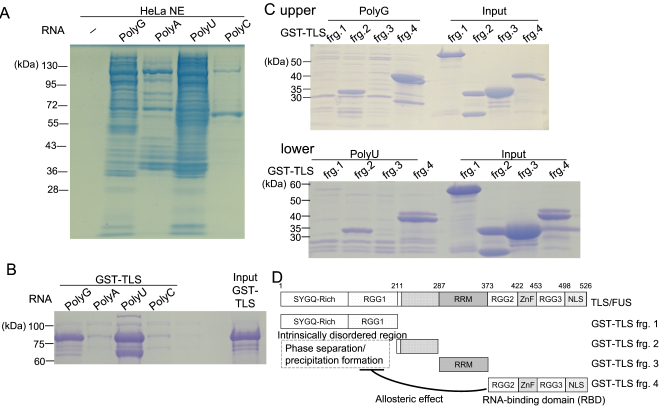
Figure 1. Poly G RNA Binds TLS and its Specific Domains.
(A) Specificity of poly GAUC-RNA on precipitation of HeLa cell nuclear extract (NE).
(B) Poly G-RNA and poly U-RNA strongly bind TLS.
(C) Poly G (upper) and U-RNAs (lower) bind fragment 2 and fragment 4.
(D) Domain structure of TLS and internal interaction between domains.
3. Results
3.1. PolyGAUC RNAs Bind RNA-Binding Proteins and TLS
We have been investigating the interaction between RNA and cellular proteins, focusing on polyGAUC RNAs (Figure 1A). PolyG and polyU RNAs bind to a remarkably diverse set of proteins in HeLa nuclear extract (NE), presumably representing RNA-binding proteins (RBPs). We then examined the interaction of polyGAUC RNAs with GST-TLS and observed strong binding signals with polyG and polyU RNAs, but virtually no binding with polyA and polyC RNAs (Figure 1B).
Using polyG and polyU RNAs, we performed domain mapping experiments on the four fragments (domains) of GST-TLS, which we have established in previous publications . The binding experiments showed that fragment 4 and also fragment 2 interact with these RNAs (Figure 1C). Fragment 4 has been identified in our previous experiments, but fragment 2 represents a novel RNA interaction domain within TLS (Figure 1D).
3.2. PolyG RNA Induces Precipitation of GST-TLS
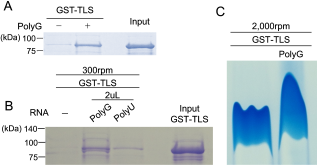
Figure 2. Poly G RNA Induces Precipitation of TLS.
(A) Examination of poly G RNA effect on TLS precipitation.
(B) Poly G RNA but not poly U-RNA induces TLS precipitation.
(C) Native Blue PAGE shows TLS-polyG RNA complex in HeLa cell NE.
Next, we examined the effect of polyG and polyU RNAs on TLS precipitation. The precipitation assay revealed robust precipitation of GST-TLS upon incubation with polyG RNA (Figure 2A). In contrast, polyU RNA did not induce substantial precipitation (Figure 2B).
We then tested whether TLS forms a molecular complex with polyG RNA. Native blue PAGE analysis showed the formation of a high-molecular-weight complex between GST-TLS and polyG RNA (Figure 2C), whereas no complex was detected with polyU RNA (data not shown).
3.3. Minimum Length of G-mers Required for TLS Interaction
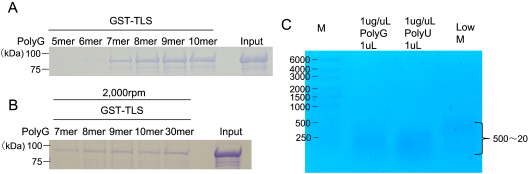
Previous data suggest that polyA RNA contains approximately 2500 adenosine residues, but no comparable data are available for polyG RNAs. We therefore investigated the minimum length of guanine repeats (G-mers) required for TLS binding and precipitation. Binding assays using oligoG RNAs ranging from 5-mers to 10-mers revealed that a G7-mer is sufficient to bind GST-TLS (Figure 3A). Precipitation assays using the same series of G-mers showed that the 7-mer also induces TLS precipitation, although the effect was marginal compared to longer polyG RNA (Figure 3B).
To estimate the approximate length of polyG RNA, we performed agarose gel electrophoresis. According to the supplier Sigma-Aldrich, the polyG RNA is enzymatically synthesized via polynucleotide phosphorylase . The gel analysis revealed smear bands corresponding to approximately 100 to 200 nucleotides (Figure 3C). In contrast, synthetic oligoG RNA from commercial nucleic acid synthesis was limited to 50 nucleotides. Therefore, it remains unclear which specific G-mer length is sufficient to induce TLS precipitation.
Figure 3. Determination of Minimum Length of G-Mer on Interaction with TLS.
(A) Just seven-mer of oligo G-RNA is enough for binding to TLS.
(B) Seven-mer of oligo G-RNA induces precipitation of TLS.
(C) Gel analysis of polyG RNA length distribution.
3.4. Potential Role of C9orf72 Repeat RNA in TLS Precipitation
Our findings thus far demonstrate that polyG RNA strongly promotes TLS precipitation. To explore whether this phenomenon may be involved in the pathogenesis of amyotrophic lateral sclerosis (ALS), we turned our attention to the GGGGCC hexanucleotide repeat expansion in the C9orf72 gene, which has been widely reported as a major genetic contributor to ALS .
Previous studies have primarily focused on the translation products of the GGGGCC repeat RNA—namely, dipeptide repeat proteins (DPRs) such as polyGA, polyGP, and polyGR—which are known to induce neuronal toxicity . However, the direct effect of the repeat RNA itself on TLS precipitation has not been thoroughly investigated.
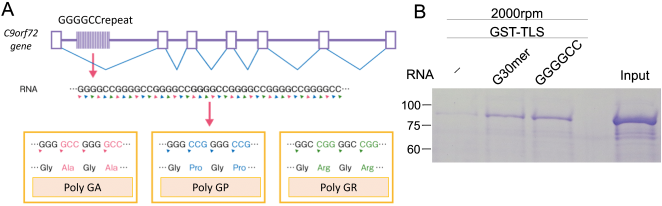
To address this, we synthesized GGGGCC repeat RNA and examined its ability to induce TLS precipitation (Figure 4A). Notably, a 30-mer of GGGGCC RNA exhibited a precipitation-promoting effect comparable to that of a 30-mer polyG RNA (Figure 4B). These results suggest that the GGGGCC repeat RNA—transcribed from the C9orf72 gene—may directly contribute to TLS misfolding and aggregation, thereby playing a role in ALS pathogenesis.
Interestingly, recent studies have shown that GGGGCC repeat RNA forms stable G-quadruplex structures , which may facilitate multivalent interactions with RNA-binding proteins such as TLS. These findings support a model in which guanine-rich RNAs, including C9orf72 repeat transcripts, promote pathological phase transitions of TLS, potentially contributing to ALS pathogenesis .
Figure 4. GGGGCC Repeat RNA Promotes TLS Precipitation.
(A) Schematic of GGGGCC repeat RNA synthesis. The diagram also shows translated dipeptides from three reading frames, which accumulate in neurons and contribute to neurotoxicity .
(B) Comparison of TLS precipitation induced by G30mer and GGGGCC repeat RNA (48mer).
4. Discussion
In this study, we demonstrated that polyG RNA binds strongly to TLS and promotes its phase separation and precipitation. Through biochemical and molecular analyses, we propose a model in which polyG RNA interacts with the RNA-binding domain in Fragment 4 of TLS, forming a complex that facilitates phase separation and precipitation via the functional activity of Fragment 1. Additionally, we identified Fragment 2 as a novel RNA-interacting domain, suggesting that its engagement with poly G RNA may further contribute to precipitation. These findings imply that polyG RNA may promote precipitation of wild-type TLS, potentially contributing to the onset of sporadic ALS. This offers a new direction for investigating the etiology of ALS cases with unknown genetic causes.
Our analysis revealed that the polyG RNA used in this study comprises a mixture of guanine repeats ranging from approximately 100 to 200 nucleotides. This suggests that numerous guanine-rich RNA transcripts in human cells may interact with TLS and other RNA-binding proteins to promote phase separation and precipitation, potentially triggering neurodegenerative diseases such as ALS. Indeed, recent transcriptomic studies have identified thousands of G-rich RNAs in human cells , many of which are capable of forming G-quadruplex structures and engaging in multivalent interactions.
If G-rich RNAs are abundantly present in neurons, TLS precipitation could occur frequently, posing a risk for ALS development. However, the rarity of ALS suggests the existence of cellular safeguards that prevent such pathological interactions. One possibility is that complementary C-rich DNA sequences form duplexes with G-rich RNA, thereby neutralizing their aggregation potential . Another hypothesis is the presence of RNA-binding proteins or molecular chaperones that selectively block TLS-G-rich RNA interactions . In healthy motor neurons, these mechanisms may suppress TLS precipitation, maintaining cellular homeostasis. Disruption of these safeguards could lead to pathological aggregation and ALS onset. Elucidating these molecular mechanisms will be essential for developing therapeutic strategies, and we are eager to pursue this line of research.
Our experiments further demonstrated that GGGGCC repeat RNA transcribed from the C9orf72 gene directly binds TLS and induces its precipitation (Figure 4) . While previous studies have focused on dipeptide repeat proteins (DPRs) translated from GGGGCC RNA as drivers of neurotoxicity , the role of the repeat RNA itself in TLS aggregation has remained underexplored. Our findings suggest that GGGGCC RNA, through its guanine-rich sequence and G-quadruplex structure , directly contributes to TLS misfolding and ALS pathogenesis .
Given the abundance of polyG RNAs—ranging from 100 to 200 guanine residues—in cells, even with protective mechanisms in place, substantial TLS precipitation may still occur. This raises the intriguing possibility that TLS-polyG RNA interactions may also contribute to beneficial cellular functions. Indeed, recent studies have proposed the concept of “functional aggregation” or “good precipitation,” where phase-separated condensates serve physiological roles . TLS precipitation may be reversible and regulated, dissolving upon RNA processing or removal. This property aligns with the behavior of certain amyloid-like aggregates involved in memory formation, such as those observed in Drosophila .
Although the precise mechanisms by which TLS precipitation contributes to memory remain unclear, the idea that RNA-mediated TLS aggregation could participate in higher-order neuronal functions is compelling. Deciphering the molecular basis of RNA-driven TLS phase transitions may thus illuminate not only disease mechanisms but also fundamental processes such as memory and cognition. This represents an exciting frontier for future research, including the development of therapeutic strategies to modulate RNA-induced phase transitions and the exploration of TLS aggregation in cognitive functions.
5. Conclusions
Our findings reveal that polyG RNA robustly induces TLS/FUS precipitation through sequence-dependent interactions involving multiple RNA-binding domains. This precipitation mechanism is distinct from classical LLPS and may contribute to the pathogenesis of ALS, particularly in cases involving C9orf72 repeat RNA. The discovery of Fragment 2 as a novel RNA-binding domain expands our understanding of TLS structure-function relationships. Furthermore, the potential physiological roles of TLS precipitation, including its involvement in memory-related processes, open new avenues for exploring functional aggregation in neurons. Future studies should aim to clarify the cellular safeguards that regulate TLS-RNA interactions and investigate therapeutic strategies to modulate pathological phase transitions.
Abbreviations

ALS

Amyotrophic Lateral Sclerosis

BISOX

Biotinylated Isoxazole

CamKIIa

Ca/calmodulin-dependent Protein Kinase Type II Subunit Alpha

CBB

Coomassie Brilliant Blue

CBP

CREB-binding Protein

CNS

Central Nervous System

DBPs

DNA-Binding Proteins

FTD

Frontotemporal Dementia

FTLD

Frontotemporal Lobar Degeneration

G4

G-Quadruplex

GR

Glucocorticoid Receptor

HAT

Histone Acetyltransferase

IDRs

Intrinsically Disordered Regions

iPS cells

Induced Pluripotent Stem Cells

lncRNA

Long Noncoding RNA

NLS

Nuclear Localization Signal

pncRNA-D

Promoter-Associated ncRNA-D

Poly G

Polyguanylic Acid

RBPs

RNA-Binding Proteins

RRM

RNA Recognition Motif

SDS-PAGE

SDS-Polyacrylamide Gel Electrophoresis

Acknowledgments
The authors thank all members of the Kurokawa laboratory for fruitful and constructive discussion. The authors also thank Christopher K. Glass and Michael Geoffrey Rosenfeld for profound insight into development of projects. This study was supported by Grant-in-Aid for Scientific Research (C: 18K06939; C 22K06904). This work was supported by the Joint Usage/Research Program on Zero-Emission Energy Research, Institute of Advanced Energy, Kyoto University (ZE2024A-15; ZE2025A-26). This work was also supported by JSPS KAKENHI Grant-in-Aid for Transformative Research Areas (B) JP 24H00838 and Grant-in-Aid for Scientific Research (C) JP 23K06392.
Author Contributions
Naomi Ueda: Data curation, Formal Analysis, Investigation, Methodology, Project administration, Resources, Validation, Visualization, Writing – review & editing
Ryoma Yoneda: Formal Analysis, Investigation, Resources, Validation, Writing – review & editing
Riki Kurokawa: Conceptualization, Data curation, Formal Analysis, Funding acquisition, Investigation, Methodology, Project administration, Resources, Supervision, Validation, Visualization, Writing – original draft, Writing – review & editing
Conflicts of Interest
The authors declare no conflicts of interest.
References
[1] Mao YS, Zhang B, Spector DL. RNA: a bridge between nuclear structure and function. Trends Genet. 2011; 27(8): 295–306.
[2] Fox AH, Lamond AI. Paraspeckles. Cold Spring Harb Perspect Biol. 2010; 2(7): a000687.
[3] Sawyer IA, Dundr M. Nuclear bodies: built to boost. Chromosoma. 2017; 126(1): 1–14.
[4] Milicevic K, Rankovic B, Andjus PR, Bataveljic D, Milovanovic D. Phase separation in neurodegeneration. Front Cell Dev Biol. 2022; 10: 840256.
[5] Patel A, Malinovska L, Saha S, Wang J, Alberti S, Krishnan Y, Hyman AA. ATP as a biological hydrotrope. Science. 2017; 356(6339): 753–756.
[6] Posey AE, Ruff KM, Harmon TS, Crick SL, Li A, Diamond MI, Pappu RV. Profilin reduces aggregation and phase separation of huntingtin N-terminal fragments. eLife. 2018; 7: e36330.
[7] Wright PE, Dyson HJ. Intrinsically disordered proteins in cellular signalling and regulation. Nat Rev Mol Cell Biol. 2015; 16(1): 18–29.
[8] van der Lee R, Buljan M, Lang B, et al. Classification of intrinsically disordered regions and proteins. Chem Rev. 2014; 114(13): 6589–6631.
[9] Uversky VN. Intrinsically disordered proteins in overcrowded milieu: membrane-less organelles, phase separation, and intrinsic disorder. Front Phys. 2019; 7: 10.
[10] Sun Z, Diaz Z, Fang X, et al. Molecular determinants and genetic modifiers of aggregation and toxicity for the ALS disease protein FUS/TLS. PLoS Biol. 2011; 9(4): e1000614.
[11] Neumann M, et al. Ubiquitinated TDP-43 in frontotemporal lobar degeneration and ALS. Science. 2006; 314(5796): 130–133.
[12] Mackenzie IR, et al. Pathological TDP-43 distinguishes sporadic ALS from ALS with SOD1 mutations. Lancet Neurol. 2010; 9(10): 995–1007.
[13] Mariani D, et al. Transcriptomic landscape of G-rich RNAs in human neurons. Nucleic Acids Res. 2024; 52(21): 13269–13289.
[14] Ueda N, Yoneda R, Kurokawa R. TLS/FUS domain analysis in RNA binding and aggregation. Biomed Sci. 2024; 10(2): 45–52.
[15] Cui W, Yoneda R, Ueda N, Kurokawa R. Arginine methylation of TLS inhibits its binding to long noncoding RNA, abrogating TLS-mediated repression of CBP/p300 activity. J Biol Chem. 2018; 293(28): 10937–10948.
[16] Hamad N, Yoneda R, So M, Kurokawa R, Nagata T, Katahira M. Non-coding RNA suppresses FUS aggregation caused by mechanistic shear stress on pipetting in a sequence-dependent manner. Sci Rep. 2021; 11(1): 9523.
[17] Simone R, et al. G-quadruplexes: emerging roles in neurodegenerative diseases. Trends Mol Med. 2015; 21(8): 513–525.
[18] Fay MM, et al. RNA G-quadruplexes are globally unfolded in eukaryotic cells and depleted in bacteria. J Mol Biol. 2017; 429(14): 2127–2147.
[19] Kharel P, et al. RNA G-quadruplexes: emerging insights into regulatory roles and therapeutic potential. Nucleic Acids Res. 2020; 48(22): 12534–12555.
[20] Yamazaki T, et al. Functional domains of TLS/FUS in phase separation and RNA binding. Mol Cell. 2018; 70(6): 1038–1053.e7.
[21] Statello L, Guo CJ, Chen LL, Huarte M. Gene regulation by long non-coding RNAs and its implications for disease. Nat Rev Mol Cell Biol. 2021; 22(2): 96–118.
[22] Lin Y, Protter DSW, Rosen MK, Parker R. Formation and maturation of phase-separated liquid droplets by RNA-binding proteins. eLife. 2015; 4: e06807.
[23] Aoki M. Clinical features of ALS in Japan. Rinsho Shinkeigaku. 2013; 53(11): 1080–1083.
[24] Vance C, Rogelj B, Hortobagyi T, et al. Mutations in FUS, an RNA processing protein, cause familial ALS. Nat Genet. 2009; 41(4): 409–414.
[25] Kwiatkowski TJ Jr, Bosco DA, Leclerc AL, et al. Mutations in the FUS/TLS gene on chromosome 16 cause familial ALS. Nat Genet. 2009; 41(4): 439–443.
[26] Bosco DA, Lemay N, Ko HK, et al. Mutant FUS proteins that cause ALS incorporate into stress granules. Nat Neurosci. 2010; 13(5): 545–552.
[27] Renton AE, Majounie E, Waite A, et al. A hexanucleotide repeat expansion in C9ORF72 is the cause of chromosome 9p21-linked ALS-FTD. Neuron. 2011; 72(2): 257–268.
[28] Mori K, Weng SM, Arzberger T, et al. The C9ORF72 GGGGCC repeat is translated into aggregating dipeptide-repeat proteins in FTLD/ALS. Science. 2013; 339(6125): 1335–1338.
[29] Fujino Y, Ueyama M, Ishiguro T, et al. GGGGCC repeat RNA promotes TLS aggregation in ALS models. eLife. 2023; 12: e84338.
[30] Ash PE, Bieniek KF, Gendron TF, et al. Unconventional translation of C9ORF72 GGGGCC expansion generates neurotoxic DPRs. Neuron. 2013; 77(4): 639–646.
[31] Smith RA, et al. Methods for analyzing RNA–protein interactions in phase separation. Methods Mol Biol. 2019; 2040: 115–126.
[32] Kato M, et al. Cell-free formation of RNA granules: low complexity sequence domains form dynamic fibers within hydrogels. Cell. 2012; 149(4): 753–767.
[33] Laemmli UK. Cleavage of structural proteins during the assembly of the head of bacteriophage T4. Nature. 1970; 227(5259): 680–685.
[34] Sugimoto N, et al. Thermodynamic characterization of G-quadruplex formation by guanine-rich RNA. Molecules. 2020; 25(21): 4936.
[35] Zhong S, et al. G-rich RNA transcripts promote phase separation of FUS through G-quadruplex formation. Acta Neuropathol. 2024; 148: 21.
[36] Yamashita R, et al. G-intron database: analysis of G-rich intronic sequences. Genome Res. 2005; 15(5): 589–601.
[37] Oyoshi T, et al. C-rich complementary sequences suppress G-quadruplex-mediated aggregation of RNA-binding proteins. Chem Pharm Bull. 2025; 73(10): 938–943.
[38] Sato K, et al. Duplex formation between G-rich RNA and C-rich DNA prevents phase separation of FUS. Brief Bioinform. 2021; 22(6): bbab321.
[39] Liu X, et al. Molecular chaperones modulate RNA-induced phase separation of FUS. Molecules. 2023; 28(15): 5801.
[40] Teng Y, et al. Chemical modulation of RNA–protein condensates: implications for neurodegenerative disease. Bull Chem Soc Jpn. 2025; 98(10): 1123–1134.
[41] Haberman N, et al. Insights into RNA–protein interactions in neurodegeneration. BMC Biol. 2024; 22: 254.
[42] Wu Y, et al. RNA-mediated phase separation of FUS in C9orf72 ALS. Neuron. 2024; 112(3): 456–472.
[43] The Lancet Neurol. Functional aggregation in neurobiology: a double-edged sword. Lancet Neurol. 2025; 24(10): 1002–1015.
[44] Hervás R, et al. Molecular basis of memory-related amyloid-like aggregates in Drosophila. Science. 2020; 367(6483): 1230–1234.
Cite This Article
  • APA Style

    Ueda, N., Yoneda, R., Kurokawa, R. (2025). PolyG RNA Induces Phase Separation and Precipitation of TLS/FUS. Biomedical Sciences, 11(4), 70-77. https://doi.org/10.11648/j.bs.20251104.11

    Copy | Download

    ACS Style

    Ueda, N.; Yoneda, R.; Kurokawa, R. PolyG RNA Induces Phase Separation and Precipitation of TLS/FUS. Biomed. Sci. 2025, 11(4), 70-77. doi: 10.11648/j.bs.20251104.11

    Copy | Download

    AMA Style

    Ueda N, Yoneda R, Kurokawa R. PolyG RNA Induces Phase Separation and Precipitation of TLS/FUS. Biomed Sci. 2025;11(4):70-77. doi: 10.11648/j.bs.20251104.11

    Copy | Download

  • @article{10.11648/j.bs.20251104.11,
      author = {Naomi Ueda and Ryoma Yoneda and Riki Kurokawa},
      title = {PolyG RNA Induces Phase Separation and Precipitation of TLS/FUS},
      journal = {Biomedical Sciences},
      volume = {11},
      number = {4},
      pages = {70-77},
      doi = {10.11648/j.bs.20251104.11},
      url = {https://doi.org/10.11648/j.bs.20251104.11},
      eprint = {https://article.sciencepublishinggroup.com/pdf/10.11648.j.bs.20251104.11},
      abstract = {Translocated in Liposarcoma (TLS), also known as Fused in Sarcoma (FUS), is a multifunctional RNA-binding protein implicated in neurodegenerative diseases due to its tendency to aggregate. While mutations in TLS are linked to familial amyotrophic lateral sclerosis (ALS), approximately 90% of ALS cases are sporadic with no known genetic mutations. In these instances, pathological aggregation of wild-type TLS is believed to play a critical role, although the molecular triggers remain elusive. RNA is known to modulate TLS phase separation, but the features that drive RNA-induced precipitation are poorly understood. Here, we report that synthetic PolyG RNA robustly induces both phase separation and irreversible precipitation of recombinant TLS in vitro. This effect is concentration-dependent and strongly influenced by RNA sequence composition. Specifically, guanine-rich RNAs such as PolyG promote aggregation, whereas uridine-rich RNAs fail to induce precipitation and may even inhibit it. These findings suggest a selective interaction between TLS and G-rich RNA sequences. Notably, the resulting TLS-RNA complexes undergo precipitation in a manner distinct from classical liquid-liquid phase separation, highlighting a unique mechanism of RNA-induced protein misfolding. Through detailed molecular biological and biochemical analyses, we further demonstrate that PolyG-induced condensates transition into solid-like aggregates over time. Our results uncover a previously uncharacterized pathway of RNA-mediated TLS aggregation and suggest that guanine-rich RNAs may contribute to pathological protein misfolding in neurodegenerative disease contexts.},
     year = {2025}
    }
    

    Copy | Download

  • TY  - JOUR
    T1  - PolyG RNA Induces Phase Separation and Precipitation of TLS/FUS
    AU  - Naomi Ueda
    AU  - Ryoma Yoneda
    AU  - Riki Kurokawa
    Y1  - 2025/12/17
    PY  - 2025
    N1  - https://doi.org/10.11648/j.bs.20251104.11
    DO  - 10.11648/j.bs.20251104.11
    T2  - Biomedical Sciences
    JF  - Biomedical Sciences
    JO  - Biomedical Sciences
    SP  - 70
    EP  - 77
    PB  - Science Publishing Group
    SN  - 2575-3932
    UR  - https://doi.org/10.11648/j.bs.20251104.11
    AB  - Translocated in Liposarcoma (TLS), also known as Fused in Sarcoma (FUS), is a multifunctional RNA-binding protein implicated in neurodegenerative diseases due to its tendency to aggregate. While mutations in TLS are linked to familial amyotrophic lateral sclerosis (ALS), approximately 90% of ALS cases are sporadic with no known genetic mutations. In these instances, pathological aggregation of wild-type TLS is believed to play a critical role, although the molecular triggers remain elusive. RNA is known to modulate TLS phase separation, but the features that drive RNA-induced precipitation are poorly understood. Here, we report that synthetic PolyG RNA robustly induces both phase separation and irreversible precipitation of recombinant TLS in vitro. This effect is concentration-dependent and strongly influenced by RNA sequence composition. Specifically, guanine-rich RNAs such as PolyG promote aggregation, whereas uridine-rich RNAs fail to induce precipitation and may even inhibit it. These findings suggest a selective interaction between TLS and G-rich RNA sequences. Notably, the resulting TLS-RNA complexes undergo precipitation in a manner distinct from classical liquid-liquid phase separation, highlighting a unique mechanism of RNA-induced protein misfolding. Through detailed molecular biological and biochemical analyses, we further demonstrate that PolyG-induced condensates transition into solid-like aggregates over time. Our results uncover a previously uncharacterized pathway of RNA-mediated TLS aggregation and suggest that guanine-rich RNAs may contribute to pathological protein misfolding in neurodegenerative disease contexts.
    VL  - 11
    IS  - 4
    ER  - 

    Copy | Download

Author Information
  • Division of Biomedical Sciences, Saitama Medical University, Saitama, Japan

  • Division of Biomedical Sciences, Saitama Medical University, Saitama, Japan

  • Division of Biomedical Sciences, Saitama Medical University, Saitama, Japan

  • Abstract
  • Keywords
  • Document Sections

    1. 1. Introduction
    2. 2. Materials and Methods
    3. 3. Results
    4. 4. Discussion
    5. 5. Conclusions
    Show Full Outline
  • Abbreviations
  • Acknowledgments
  • Author Contributions
  • Conflicts of Interest
  • References
  • Cite This Article
  • Author Information